February 6, 2026
Your company just closed its biggest quarter yet. Sales are up 40%, customer acquisition is accelerating, and your board is thrilled. Then your operations director sends you a message that stops you cold: "Our current system can't handle this volume. We're manually processing orders again."
This scenario plays out more often than most business leaders admit. The very success that validates your business model becomes the constraint that limits your next phase of growth. Off-the-shelf software got you here, but it won't get you there.
Custom software development isn't about replacing what works - it's about removing the ceiling on what's possible.
Why Standard Solutions Create Scalability Bottlenecks
Most growing companies start with packaged software because it makes sense. Quick implementation, predictable costs, proven functionality. But standard solutions are designed for the average use case, and by definition, your competitive advantage isn't average.
The problems surface gradually. First, you're building workarounds - exporting data to spreadsheets, using multiple tools that don't communicate, assigning team members to manual data entry that should be automated. These aren't just inefficiencies; they're structural barriers that compound as you scale.
I've seen a logistics company processing 200 shipments daily with software designed for 50. Their workaround involved three different systems and a team member who spent six hours daily reconciling data across platforms. When order volume doubled, they couldn't simply hire two people for that role - the process itself had become the bottleneck.
The Scalability Advantage of Purpose-Built Software
Custom software development creates growth capacity in three specific ways that directly impact your bottom line.
Automation of Business-Critical Workflows
The highest-value automation isn't about replacing human judgment - it's about eliminating repetitive decision-making that drains your team's capacity to focus on strategic work.
A manufacturing client was manually reviewing supplier quotes across seven different vendor portals, comparing specifications, checking inventory levels, and creating purchase orders. The process took three people working full-time. Custom software automated the data aggregation, applied business rules they'd refined over the years, and flagged only the exceptions requiring human review. The same team now manages 3x the supplier relationships while focusing on negotiation and relationship management instead of data entry.
That's not a story about reducing headcount. It's about redirecting skilled employees toward work that actually drives competitive advantage.
Data Integration That Reflects Your Operations
Your business doesn't operate in neat silos, but your software probably does. CRM talks to marketing automation, sometimes. Inventory management connects to accounting, kind of. Customer service sees one version of the truth, fulfillment sees another.
Custom development creates a unified data architecture that mirrors how your business actually functions. When a customer service representative can see real-time inventory, current production schedules, and shipping status without switching systems, they're not just more efficient - they're delivering a customer experience your competitors can't match with disconnected tools.
This integration becomes even more critical as you implement AI and machine learning capabilities. Predictive analytics and intelligent automation require clean, accessible data across your entire operation. Custom software provides the foundation that makes those advanced capabilities possible.
Flexibility to Evolve With Market Demands
The business model that drives your growth today will need refinement tomorrow. Custom software is built to change.
I worked with a subscription-based service that needed to experiment with new pricing models to address different market segments. Their packaged billing system required a six-month vendor roadmap discussion and custom pricing just to implement basic tiering changes. They built a custom billing engine instead. Now they can test new pricing models in days, measure results, and iterate based on real customer response. That velocity of experimentation became a strategic advantage.
The Real Cost Equation Nobody Discusses
The objection I hear most frequently: "Custom software development costs more than buying something off the shelf."
That's true, the same way buying a building costs more than renting office space. The question isn't which has a lower initial price tag - it's which creates more value over time.
Calculate the actual cost of your current approach. Add up the subscription fees across all the tools you're using. Include the salary cost of employees managing workarounds, manual processes, and data reconciliation. Factor in the revenue you're not capturing because your systems can't support new product lines or service offerings. Don't forget the customer lifetime value you're losing to poor experiences caused by system limitations.
For most growing companies, that number is significantly higher than they expect. And it's not a one-time expense - it's an ongoing tax on growth.
Custom software development requires a larger upfront investment, but the total cost of ownership typically crosses the break-even point within 18-24 months for mid-sized companies. After that, you're building equity in an asset that compounds value instead of renting a capability that stays static.
Common Mistakes That Undermine Custom Development Projects
Even companies that recognize the value of custom software often stumble in execution. Three mistakes account for the majority of failed projects.
Building for today instead of tomorrow. Requirements-gathering that focuses exclusively on current pain points creates software that's already outdated by launch. Effective custom development anticipates where your business is heading and builds architecture that can scale into that future.
Ignoring security and compliance from the start. Adding security controls and compliance capabilities after the fact costs 10x more than building them into the foundation. If you're handling customer data, payment information, or operating in a regulated industry, security architecture needs to be part of the initial design, not a phase two consideration.
Treating QA as an afterthought. Quality assurance isn't something that happens at the end of development - it's woven throughout the process. Automated testing, continuous integration, and thorough documentation aren't nice-to-haves; they're what separates software that drives growth from technical debt that slows you down.
How AI and Cloud Technologies Amplify Custom Solutions
The conversation around custom software development has fundamentally changed in the past 18 months. Generative AI, large language models, and increasingly sophisticated automation tools are reshaping what's possible.
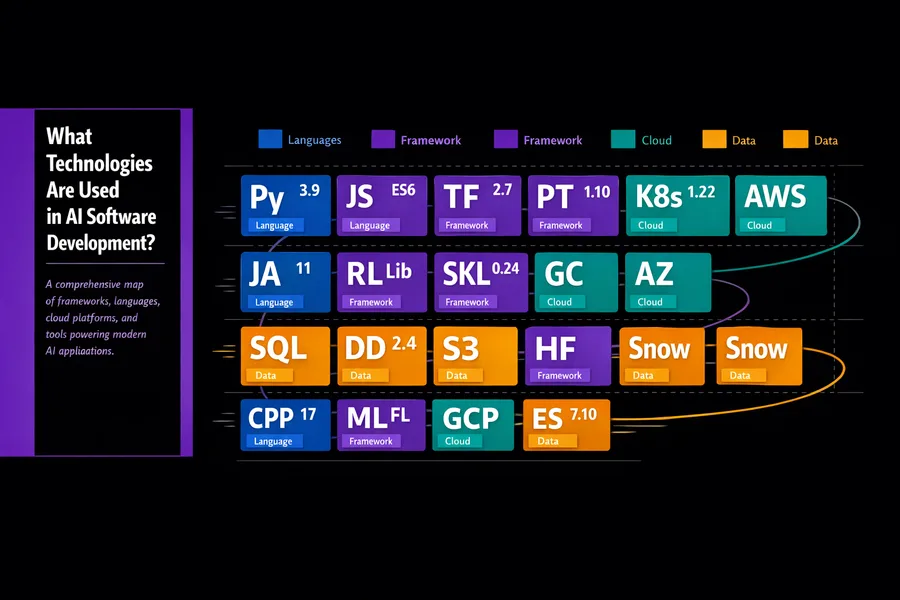
Custom software can now incorporate AI capabilities that were enterprise-only technology 24 months ago. Natural language processing for customer service, predictive analytics for inventory management, intelligent document processing for compliance - these aren't futuristic concepts; they're production capabilities being deployed in mid-market companies today.
Cloud infrastructure has similarly transformed the scalability equation. Custom software built on cloud-native architecture can scale computing resources dynamically based on demand. You're not provisioning for peak capacity and paying for unused servers during slower periods - you're paying for exactly what you use when you use it.
This combination - custom software designed specifically for your business model, enhanced with AI capabilities, running on cloud infrastructure - creates a technology foundation that can scale orders of magnitude without proportional increases in cost or complexity.
The Modernization Imperative
If you're running business-critical processes on software built more than five years ago, you're operating with a growing vulnerability. Not just technical debt, though that's real. You're vulnerable to competitors who are building on modern architecture that lets them move faster, serve customers better, and operate more efficiently.
Legacy system modernization is one of the most valuable investments a growing company can make. The key is approaching it strategically — you don't need to rebuild everything at once. Identify the highest-value processes, the ones most critical to growth or most constrained by current systems, and modernize those first. Build on cloud architecture. Implement an API-first design that makes future integration straightforward. Create the foundation for continuous evolution instead of another monolith that will need replacement in a decade.
Building Growth Capacity Through Software
The companies that scale successfully don't just sell more of what they already offer—they build capacity to serve customers better, enter new markets faster, and adapt to changing conditions more effectively than the competition.
Custom software development is how you build that capacity. It's not a technology decision; it's a growth strategy decision.
The right approach starts with a deep understanding of your business model, clear identification of constraints limiting growth, and an honest assessment of where custom software creates the highest value. It requires partnership with software development experts who understand both technology architecture and business operations.
Most importantly, it requires thinking beyond the next quarter. The software you build today should be the foundation that supports your business three years from now, when you're operating at a scale you can barely imagine currently.