February 13, 2026
The SaaS renewal email hits your inbox, and you do the math. Another 12% price increase. That's three years running. Your finance team is already asking questions about the software budget, which somehow grew by 40% while headcount increased by only 15%.
But the real frustration isn't the cost—it's that you're paying more for software that still doesn't do what you actually need. Your sales team is still exporting data to spreadsheets. Your operations people have built an elaborate system of workarounds involving three different tools. And your newest product line? It doesn't fit into any of the packaged solutions you're already paying for.
You're not alone. A significant shift is happening across mid-market and enterprise companies. Businesses that built their tech stack on off-the-shelf tools are increasingly making the move to custom software development. Not because packaged solutions are bad, but because the math has fundamentally changed.
The Hidden Costs of "Ready-Made" Software
Off-the-shelf tools promise simplicity. Fast implementation, predictable monthly fees, somebody else handling updates and maintenance. For early-stage companies and standard use cases, that value proposition still holds.
But as businesses grow and differentiate, the hidden costs start accumulating in ways that don't show up on the software budget line.
The Integration Tax
You're probably running 10-15 different SaaS tools right now. CRM, project management, customer support, marketing automation, analytics, accounting, inventory management—the list goes on. Each one solves a specific problem reasonably well. The nightmare is making them work together.
A healthcare services company I worked with was using five different platforms to manage the patient journey from initial contact through service delivery and billing. Each platform had APIs, theoretically. In practice, they employed two full-time developers just maintaining integrations and building middleware to keep data synchronized. When one vendor pushed an API update, the integrations broke. Patient data ended up in inconsistent states. The support tickets piled up.
That integration maintenance cost—in both salary and opportunity cost—never appears in the SaaS ROI calculation. But it's real, it's ongoing, and it grows with every tool you add to the stack.
The Customization Ceiling
Most packaged software offers some level of customization. Custom fields, workflow configurations, maybe even some scripting capability. Then you hit the wall.
A logistics company needed to implement specific compliance tracking for international shipments. Their transportation management system had custom fields, but couldn't enforce the conditional logic required by different destination countries. Their workaround involved manual checklists, separate tracking spreadsheets, and a dedicated compliance coordinator who spent 60% of their time on data entry that should have been automated.
They weren't asking for something exotic—just business logic specific to their regulatory requirements and competitive positioning. The TMS vendor put it on their roadmap. Eighteen months later, it still wasn't implemented.
The Feature Bloat Problem
Packaged software vendors serve thousands of customers across different industries and use cases. To appeal to everyone, they build features most companies never use. You're paying for and navigating around functionality designed for problems you don't have.
Your team needs six specific capabilities to do their jobs effectively. The software you bought delivers those six, plus forty others that clutter the interface, slow down performance, and require training time on features you'll never touch.
Custom software development inverts this equation. You get exactly what drives value for your business, nothing more. The interface is clean because it only includes what your team actually uses.
Why the Calculation Has Shifted
Five years ago, custom software development meant significant upfront investment, long timelines, and ongoing maintenance challenges. Three factors have fundamentally changed that equation.
Cloud Infrastructure Maturity
Building custom software used to mean provisioning servers, managing infrastructure, planning for capacity, and employing a team to keep everything running. Cloud platforms have abstracted away that complexity.
Development Framework Evolution
The tools for building software have advanced dramatically. Modern frameworks, component libraries, and development platforms have accelerated the build process while improving quality and maintainability.
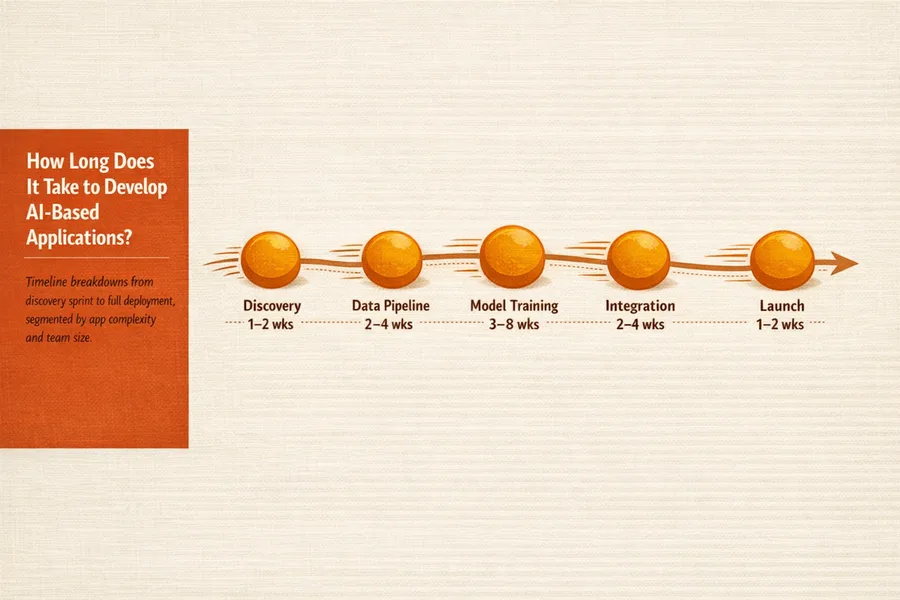
A custom application that might have required nine months to develop five years ago can now be built in three to four months without sacrificing quality or long-term viability. The development timeline gap between "buy" and "build" has narrowed significantly.
AI-Enhanced Development Capabilities
Generative AI and large language models are already changing how custom software gets built. Not through AI writing all the code—that's mostly hype—but through AI assisting with specific development tasks, automated testing, documentation, and code review.
These capabilities reduce development time and cost while improving code quality. They also make it more practical to build sophisticated features that would have been too time-intensive to justify in custom projects just 18 months ago.
When Custom Software Makes Strategic Sense
Not every company needs custom software for everything. The decision should be strategic, not reflexive. Three scenarios make custom development the clear choice.
Your Process Is Your Competitive Advantage
If you've developed proprietary workflows, unique service delivery methods, or operational processes that differentiate you from competitors, off-the-shelf software actively works against you. It forces you to adapt your advantage to fit standard processes.
A professional services firm had developed a specific client onboarding and project methodology that directly correlated with higher retention and satisfaction scores. None of the available project management platforms supported their workflow without significant compromises. They built custom software that codified their methodology, made it consistent across all client engagements, and became a training tool for new team members.
That's not software supporting the business—it's software that is the business model.
You're Scaling Beyond Standard Tool Limitations
Growing companies hit inflection points where packaged software simply can't handle the volume, complexity, or specific requirements of their operations.
An e-commerce company processing 50,000 orders monthly fits comfortably in most platforms. At 500,000 orders with complex fulfillment logic, custom inventory routing, and integration with proprietary warehouse systems, those platforms start breaking down. The workarounds become more expensive than purpose-built software.
Data Architecture Requires Unification
If your business depends on real-time data access across multiple operational areas, the fragmented data architecture of multiple SaaS tools creates fundamental limitations.
A financial services company needed to provide advisors with a unified client view combining relationship data, portfolio performance, planning scenarios, and communication history. Their existing tools each held pieces of this puzzle, but creating that unified view required extensive ETL processes and data warehousing that was expensive, slow, and fragile.
Custom software with integrated data architecture solved the problem at its root instead of building increasingly complex workarounds on top of disconnected systems.
Common Misconceptions About Custom Development
Business leaders often hesitate on custom software based on outdated assumptions or myths that don't reflect current reality.
"We don't have the in-house expertise to manage custom software." You don't need an internal development team to benefit from custom software. Many companies work with development partners who handle ongoing maintenance, updates, and enhancements. The key is choosing partners who think like business consultants, not just code writers.
"Custom software takes too long to see ROI." The timeline to value depends entirely on how the project is scoped and executed. Phased approaches that deliver core functionality first, then iterate based on real usage, can show positive ROI within six to twelve months.
"We'll get locked into a single vendor." This risk exists, but it's manageable through proper contracting, documentation standards, and modern development practices. Many companies actually find themselves more locked into SaaS platforms than well-documented custom code.
The Security and Compliance Advantage
For companies in regulated industries or those handling sensitive customer data, custom software development offers security and compliance capabilities that off-the-shelf tools can't match.
You control exactly how data is stored, processed, and protected. You can implement industry-specific security requirements from the ground up rather than trying to configure generic security features to meet specialized needs. When compliance requirements change, you can update your systems immediately instead of waiting for a vendor to add support.
A healthcare technology company needed to meet HIPAA requirements while also complying with state-specific privacy regulations that varied by patient location. Their packaged solutions handled HIPAA reasonably well, but couldn't accommodate the state-level variations. Custom software lets them build exactly the logic required for compliant operations across all their markets.
Building for Tomorrow's Requirements
The strongest argument for custom software isn't about solving today's problems—it's about creating a foundation that evolves with your business.
Off-the-shelf tools improve on the vendor's timeline based on their aggregate customer needs. Custom software improves on your timeline based on your specific strategic priorities.
As AI capabilities advance, as new integration requirements emerge, as your business model shifts in response to market conditions, custom software can adapt. You're not waiting for vendor roadmaps or working around platform limitations.
Making the Transition
Moving from off-the-shelf tools to custom software doesn't mean replacing everything at once. The most successful transitions happen incrementally.
Start with the highest-value opportunity—the process most constrained by current software limitations or the integration that's causing the most pain. Build custom software for that specific need. Prove the concept, demonstrate ROI, and learn from the experience before expanding the scope.
This approach reduces risk, builds internal confidence in custom development, and creates reference points for evaluating future build-versus-buy decisions. A good software maintenance partner can also help you keep both existing tools and new custom systems running smoothly during the transition.