An honest, detailed look at what AI software development actually costs in the United States in 2026 — from quick proof-of-concept builds to full enterprise deployments — and the factors that drive costs up or down.
Why Pricing AI Projects Is Complicated
AI software development costs more to estimate accurately than traditional software because so much depends on data readiness, model complexity, and the degree of accuracy required. A vendor who quotes a firm price before reviewing your data is either very experienced with an extremely narrow use case or is setting you up for change orders.
That said, the market has matured enough that credible budget ranges now exist for different categories of work. What follows is a breakdown organized by project scope and the key cost drivers within each.
Hourly Rates by Role and Location (2026 U.S. Market)
Understanding hourly rates helps you assess vendor quotes and make build-versus-buy decisions:
- Senior Data Scientist / ML Engineer (U.S. domestic): $175 to $300 per hour through an agency; $140,000 to $220,000 annual fully loaded cost for full-time hire
- AI Software Engineer (U.S. domestic): $150 to $250 per hour; $120,000 to $190,000 annual for full-time
- MLOps / Data Engineering (U.S. domestic): $140 to $230 per hour; $115,000 to $175,000 annual
- Eastern European specialist firms: $65 to $110 per hour depending on seniority and location
- South Asian development firms: $40 to $75 per hour; quality and expertise vary considerably
- Latin American nearshore firms: $60 to $100 per hour; growing talent pool with favorable time zones for U.S. teams
Project Cost Tiers
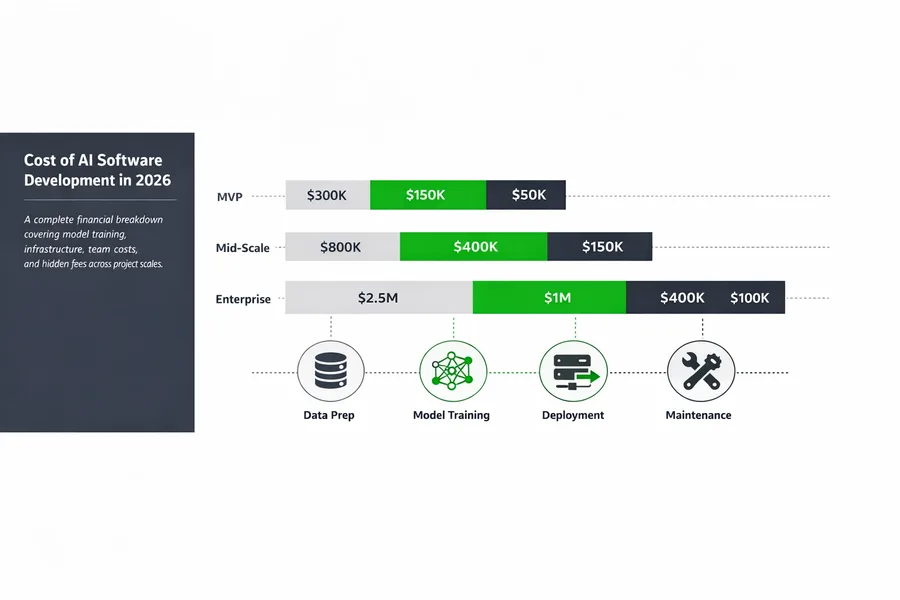
Tier 1: Proof of Concept or MVP — $15,000 to $80,000
A proof of concept (POC) answers the question: can AI actually solve this problem with the data we have? It typically involves data exploration, building and evaluating one or two candidate models, and a simple interface or API that demonstrates the capability. A POC does not go into production — it validates feasibility and provides the evidence needed to justify a larger investment.
At this tier you are likely using pre-trained models, existing cloud AI services, or open-source frameworks rather than building novel architectures from scratch. The work is fast and focused. Budget for four to twelve weeks of elapsed time.
Tier 2: Production-Ready Single-Use-Case Application — $80,000 to $350,000
This is the most common engagement size for mid-market U.S. businesses. The scope includes everything a POC covers, plus production-grade data pipelines, model deployment infrastructure, integration with existing business systems, a user interface, security hardening, and initial monitoring setup.
Example use cases at this tier include an intelligent document processing system, a predictive maintenance tool for manufacturing equipment, a customer churn prediction model integrated with a CRM, or a conversational AI assistant for internal helpdesk functions.
Tier 3: Enterprise AI Platform — $350,000 to $2,000,000+
Enterprise-scale AI initiatives involve multiple use cases, integration across many systems, organizational change management, and governance infrastructure. These projects require larger, more diverse teams and typically unfold over twelve to thirty-six months.
Budget at this tier also includes substantial spend on cloud infrastructure, data platform modernization (if your data architecture is not AI-ready), security and compliance work, and internal training to ensure staff can actually use and trust the new tools.
Key Cost Drivers
Understanding these factors helps you prioritize where to invest and where to look for savings:
- Data quality and availability — Every hour spent cleaning, labeling, or collecting data costs money. Organizations with clean, well-labeled historical data have a substantial cost advantage. If you are starting from raw, unstructured data, add 20 to 40 percent to your data preparation budget.
- Model complexity and accuracy requirements — A model that needs to be right 99.9 percent of the time costs far more to develop and validate than one where 90 percent accuracy is acceptable. The last few percentage points of accuracy improvement often require disproportionate investment.
- Integration complexity — Integrating with a modern REST API is straightforward. Integrating with a 30-year-old mainframe, a complex ERP system, or dozens of different data sources is not. Get a clear picture of your integration landscape before finalizing budgets.
- Compliance and security requirements — Healthcare, financial services, and defense-adjacent industries have regulatory requirements that add meaningful cost: encrypted data storage, audit logging, bias documentation, explainability requirements, and formal model validation processes.
- Cloud infrastructure — Cloud AI workloads can be expensive, particularly during training of large models. A well-designed cloud architecture with appropriate instance types, auto-scaling, and cost monitoring is worth investing in from the start.
Hidden Costs to Budget For
- Data labeling — Manual annotation of training data can cost anywhere from a few thousand to tens of thousands of dollars depending on volume and complexity
- Ongoing model retraining — Plan for quarterly to annual retraining cycles as production data evolves
- Monitoring infrastructure — Tools for tracking model performance in production
- Internal change management — Training staff and adapting workflows to trust and use the new AI system
- Legal and compliance review — Particularly for customer-facing AI applications
Budget Tip: Treat the first year's total cost of ownership — not just development — as your true investment. A $200,000 build with $50,000 in annual operating costs is a different financial commitment than a $200,000 build that costs $150,000 per year to run and maintain. Our AI development services include transparent cost breakdowns before any commitment.