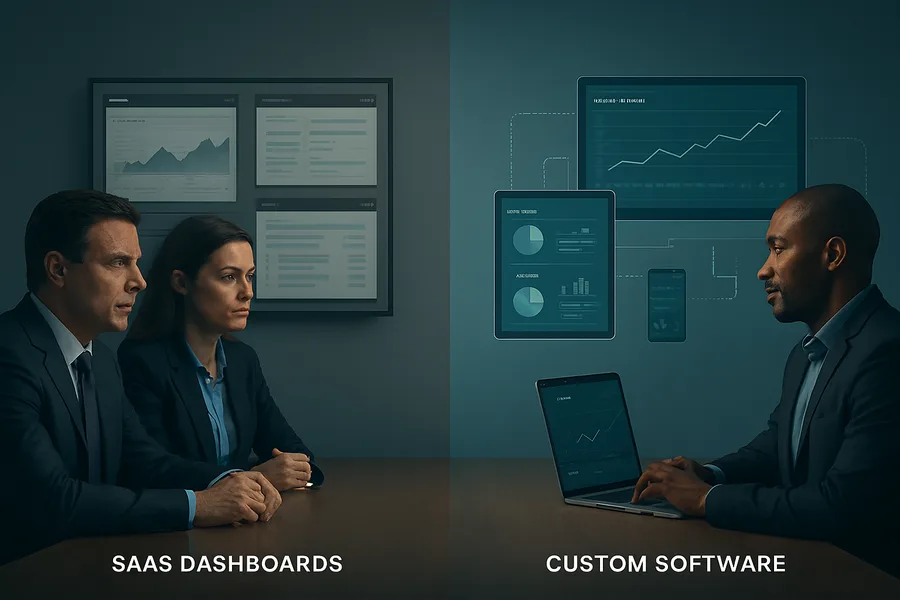
Your CFO just forwarded the annual SaaS spending report, and the number is staggering. Somehow, your software subscriptions increased 35% while headcount only grew 12%. You're paying for seats nobody uses, features your teams ignore, and integrations that barely work.
But the alternative custom software development comes with its own concerns. Higher upfront investment, longer timelines, and ongoing maintenance responsibilities. Your last custom project ran over budget and took twice as long as promised.
So you're stuck in the middle, watching SaaS costs compound while wondering if custom development would actually solve problems or just create different ones.
This isn't a question with a universal answer. The right choice depends on variables specific to your business model, competitive positioning, growth trajectory, and operational complexity. But there is a framework for making this decision intelligently instead of defaulting to whichever option seems less risky.
The Real Cost Comparison Nobody Shows You
Most SaaS versus custom software analyses focus on obvious costs—subscription fees versus development budgets. That comparison misses the larger economic picture.
The SaaS Cost Curve Over Time
SaaS pricing starts low and scales linearly with usage. That's the whole appeal. But "linearly" is the problem. As your business grows, so does your software spend, often faster than revenue growth.
A professional services firm tracked their core SaaS tools over five years. Year one: $85,000 in annual subscriptions. Year five: $340,000. Revenue grew 2.5x in that period. Software costs grew 4x.
The increase came from three sources. First, vendor price increases averaging 8-12% annually. Second, user count growth as the company expanded. Third, feature tier upgrades as they outgrew entry-level plans.
That cost trajectory is predictable and ongoing. You're paying more forever, and the vendor captures an increasing percentage of your revenue growth.
The Custom Software Investment Model
Custom software inverts this equation. Higher upfront investment, then dramatically lower ongoing costs relative to business scale.
A logistics company spent $280,000 developing custom route optimization and dispatch software. Annual maintenance and hosting costs run about $35,000. They're in year four. Total investment: $420,000.
The comparable SaaS solution would have cost $65,000 in year one, scaling to approximately $95,000 annually by year four based on their growth and user count. Five-year SaaS cost: roughly $390,000.
The numbers are close—but that's where most analyses stop. The SaaS cost continues compounding. Years six through ten will add another $550,000 minimum. The custom software maintenance cost stays relatively flat. By year ten, the custom solution has saved over $400,000 while delivering capabilities specifically designed for their operational model rather than generic features.
This math doesn't favor custom development for every company, but it's the actual calculation you need to run.
When SaaS Makes Strategic Sense
Despite everything I just said, SaaS is absolutely the right choice in specific circumstances. Understanding when is as important as understanding when it isn't.
Standard Processes Without Competitive Differentiation
If you're using software for business processes that don't differentiate you from competitors, SaaS almost always makes sense. Email, document collaboration, basic accounting, HR management—these are table stakes, not competitive advantages.
A manufacturing company uses off-the-shelf tools for internal communication, file sharing, and benefits administration. Those processes need to work reliably, but optimizing them doesn't drive revenue or create market differentiation. SaaS delivers exactly what they need without unnecessary investment.
They built custom software for production planning and quality control because those processes directly impact their market positioning and customer satisfaction. That's where custom development creates value SaaS can't match.
Rapidly Evolving Feature Requirements
Some business domains move so quickly that the development timeline for custom software means you're building for yesterday's requirements. SaaS vendors serving these markets often iterate faster than internal development teams can.
Marketing automation is a good example. The platforms, channels, and tactics change constantly. SaaS providers in this space update features monthly, responding to platform API changes and new marketing channels as they emerge. Building custom marketing automation means committing resources to keeping pace with changes that are tangential to your core business.
Unless marketing automation is your competitive advantage—meaning you've developed proprietary approaches that generic tools can't support—SaaS is probably the better choice.
Limited Technical Resources
Custom software requires ongoing technical support. If you lack internal technical expertise and aren't prepared to engage long-term development partners for maintenance and evolution, SaaS transfers that responsibility to the vendor.
A small financial advisory firm needs client portfolio management and reporting tools. They don't have technical staff and don't want to become software managers. SaaS gives them professional-grade capability without building internal technical capacity.
As they scale and their client service model becomes more sophisticated, they may hit SaaS limitations. At that point, they can reevaluate with better understanding of requirements and more resources to support custom development.
The Custom Software Advantage
Custom development creates value in three specific ways that SaaS fundamentally cannot deliver, regardless of how sophisticated the platform or how many configuration options it offers.
Competitive Process Differentiation
If your competitive advantage comes from how you deliver services, how you operate internally, or how you serve customers, then software that embeds and enforces those processes becomes strategic infrastructure.
A healthcare services company developed a specific care coordination methodology that improved patient outcomes while reducing costs. Their process involved timing, sequencing, and collaboration patterns that didn't fit any available care management platform.
They built custom software that codified their methodology, ensured consistent application across all patient engagements, and captured data that validated the approach's effectiveness. That software became part of their competitive moat—not because the code was proprietary, but because it enabled differentiated service delivery.
No SaaS platform could deliver that value because the value comes from the specificity, not the features.
Integration Architecture That Reflects Your Operations
SaaS tools excel at doing one thing well. The problems start when you need ten SaaS tools to work together seamlessly.
A distribution company ran their operations across separate platforms for inventory management, order processing, customer relationship management, warehouse operations, and shipping logistics. Each tool worked fine independently. Making them work together required constant data synchronization, manual reconciliation, and multiple staff members managing integrations.
Custom software with integrated data architecture eliminated the integration complexity. One unified system with purpose-built modules for each operational area, all sharing a common database and business logic layer.
The efficiency gain wasn't from better features—it was from eliminating the friction of disconnected systems. Their operations team spent 60% less time on data management and system coordination, redirecting that capacity to actual customer service and optimization work.
Data Ownership and Competitive Intelligence
SaaS platforms own your data architecture, and often your actual data. That's fine until you want to do something the platform doesn't support or extract insights the vendor's analytics don't provide.
Custom software means you control the data model, the storage architecture, and access to raw data for analysis. As AI and machine learning capabilities become more accessible, this control enables competitive intelligence that SaaS platforms can't facilitate.
A retail company built custom inventory and demand forecasting software. As generative AI and large language models matured, they integrated predictive analytics that analyzed purchasing patterns, seasonal trends, supplier reliability, and external factors like weather and local events.
Their SaaS-based competitors use vendor-provided forecasting algorithms—the same algorithms their competitors use. The custom software company develops proprietary forecasting models trained on their specific data and market dynamics. That's a compounding advantage SaaS can't replicate.
The Hybrid Approach Most Companies Actually Need
The custom versus SaaS decision isn't binary. The most sophisticated technology strategies use both, deployed strategically based on where each creates the most value.
Core Systems Custom, Peripheral Tools SaaS
Map your technology needs by proximity to competitive advantage. Software that touches core business processes, customer experience, or competitive differentiation should be custom. Everything else can be SaaS until you outgrow available options.
A fintech company built custom software for their core lending platform and risk assessment algorithms. They use SaaS for internal collaboration, customer support ticketing, and email marketing. The resources they save on non-differentiating systems fund ongoing investment in their proprietary platforms.
This approach maximizes return on development investment while avoiding custom software for problems that don't require it.
Incremental Migration Based on ROI
You don't need to replace your entire SaaS stack at once. Identify the highest-value opportunities—where SaaS limitations are most constraining or where costs have become disproportionate—and migrate those systems to custom development incrementally.
An e-commerce company started with SaaS for everything. As they scaled, their inventory management system became the constraint. They built custom inventory and warehouse management software while keeping SaaS tools for accounting, HR, and customer support.
Two years later, order volume had grown enough that their e-commerce platform subscription costs justified custom development. They migrated that system next. The incremental approach reduced risk, proved ROI before expanding scope, and built internal confidence in custom development.
Common Decision-Making Mistakes
Business leaders evaluating this choice often make predictable errors that lead to regret regardless of which option they select.
Optimizing for Initial Cost
Choosing based on which option has the lowest near-term cost ignores the total economic impact over the useful life of the software. SaaS almost always wins on year-one cost. Custom development frequently wins on five-year total cost of ownership for systems that will be used long-term.
Run the actual numbers for your specific situation across a realistic timeframe. Include SaaS price escalation, expected user growth, feature tier changes, and the opportunity cost of SaaS limitations. Compare that to custom development costs including ongoing maintenance and enhancement.
The answer might surprise you.
Underestimating SaaS Limitations
SaaS demos show polished features and smooth workflows. Production reality includes integration challenges, feature gaps, inflexible workflows, and vendor support delays when you need custom functionality.
Before committing to SaaS for critical business processes, implement a proof-of-concept with real data and actual users. The limitations that aren't obvious in demos become painfully clear when your team tries to do their actual jobs.
Overestimating Custom Development Risk
Custom software projects certainly fail, but so do SaaS implementations. The difference is custom development failures get more visibility while SaaS failures often manifest as ongoing operational friction that never gets attributed to the software choice.
The risk in custom development isn't the approach—it's execution quality, which is why partner selection matters enormously. Working with development firms that have relevant experience, proven methodology, and client references dramatically reduces risk.
Looking Forward: AI's Impact on the Equation
Generative AI and increasingly sophisticated development tools are changing the economics of custom software development. Building custom applications is faster and less expensive than it was 24 months ago, and that trend is accelerating.
At the same time, AI capabilities make custom software more powerful. You can embed AI features specific to your business needs, trained on your proprietary data, delivering competitive advantages that generic SaaS AI features can't match.
This shift favors custom development for a broader range of use cases than historically made economic sense. The decision calculus that favored SaaS five years ago may point toward custom software today for the same business requirements.