A plain-language breakdown of AI software development — what it actually means, why businesses everywhere are adopting it, and the mechanics behind how it functions.
Defining AI Software Development
If you have used a streaming service that recommends your next show, asked a virtual assistant a question, or received a fraud alert from your bank before you even noticed a strange charge — you have already experienced AI software in action. But what goes on behind the scenes? AI software development is the discipline of designing, building, testing, and deploying applications that can perform tasks requiring human-like reasoning: learning from data, identifying patterns, making predictions, and adapting their behavior over time.
Unlike traditional software, which follows a rigid set of rules a programmer has hand-coded, an AI-powered application can update its own logic based on new information. That distinction is not trivial. A traditional fraud-detection program would flag a transaction only if it matched a pre-written rule — say, a charge over a certain dollar amount made in a foreign country. An AI fraud-detection system, by contrast, learns the spending habits of individual users and flags anything that deviates from those personal patterns, catching fraud that rigid rules would miss entirely.
In the United States, AI software development has become one of the most active areas in the technology sector. From Silicon Valley startups to Wall Street banks to Midwest manufacturers, organizations of every size and industry are investing in software that can think — at least in functional terms — rather than just execute.
The Core Idea: Teaching Machines to Learn
The phrase 'artificial intelligence' covers a broad family of techniques, but they all share a central ambition: giving computers the ability to improve at tasks without being explicitly programmed for every possible scenario. The main branches you will encounter in modern software development are:
Machine Learning (ML): The foundational layer. ML systems are trained on large datasets and use that training to make predictions on new, unseen data. A spam filter trained on millions of labeled emails learns to distinguish promotional messages from genuine ones — without a human writing rules for every possible subject line.
Deep Learning (DL): A subset of ML that uses layered neural networks loosely inspired by the human brain. Deep learning excels at tasks involving unstructured data — images, audio, and natural language. It powers everything from facial recognition to voice assistants to the translation tools you use when reading a foreign-language website.
Natural Language Processing (NLP): The technology that lets computers read, understand, and generate human language. NLP is behind chatbots, document summarization tools, sentiment analysis platforms, and large language models like the ones that have captured public attention in recent years.
Computer Vision: Gives software the ability to interpret visual inputs — photos, video frames, medical scans. Self-driving vehicle systems, quality-control cameras on factory floors, and retail checkout systems that identify items without barcodes all rely on computer vision.
Reinforcement Learning (RL): A training approach in which a software agent learns by trial and error, receiving rewards for good decisions and penalties for bad ones. RL is used in robotics, game-playing systems, and increasingly in optimizing complex logistics networks.
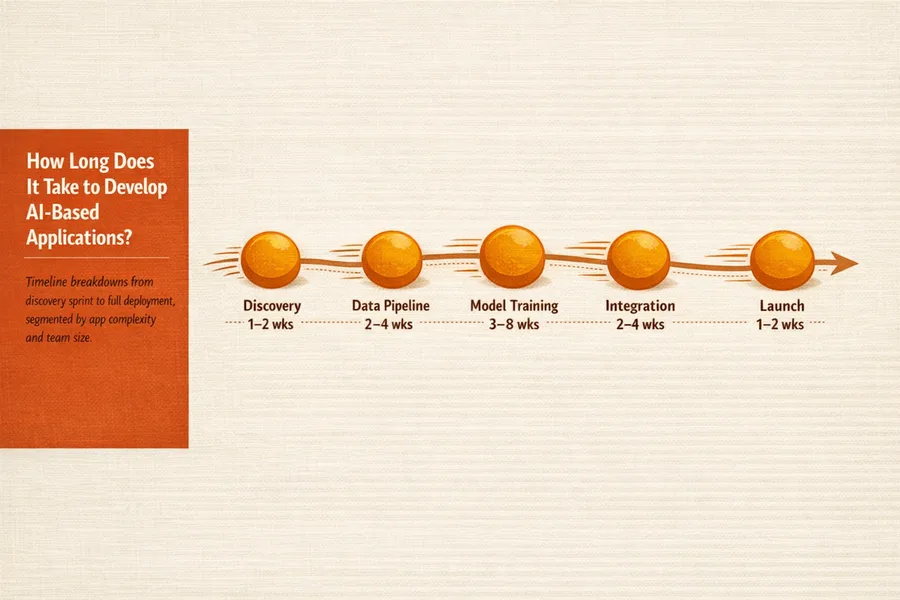
How the Development Process Actually Works
Building an AI application is fundamentally different from building a conventional web app or mobile tool. The process has a research dimension that most software projects lack. Here is a simplified look at the workflow:
- Problem definition — The team identifies a specific, measurable problem that data-driven intelligence can realistically solve. Vague goals like 'make the business smarter' are replaced with concrete targets: 'reduce customer churn by 15 percent' or 'cut invoice processing time in half.'
- Data collection and preparation — AI systems learn from data, so collecting sufficient, high-quality training data is often the longest and most expensive phase. Raw data is cleaned, labeled, and formatted into structures the training algorithms can consume.
- Model selection and training — Engineers choose an algorithm appropriate for the problem type and feed it the prepared data. The model iterates through the data many times, adjusting internal parameters until it can make accurate predictions.
- Evaluation and tuning — The trained model is tested against data it has not seen before. Engineers measure accuracy, identify weaknesses, and fine-tune the model to address them — a process that can cycle multiple times before the team is satisfied.
- Integration and deployment — The validated model is packaged into an API or embedded directly into the target application. It is then deployed to production infrastructure — cloud servers, edge devices, or on-premises hardware, depending on the use case.
- Monitoring and retraining — AI models can drift over time as real-world data patterns shift. Ongoing monitoring tracks model performance, and periodic retraining keeps the system accurate and useful.
Why AI Software Development Is Different from Regular Coding
Traditional software development is largely deterministic: given the same inputs, the program always produces the same outputs. AI development is probabilistic. A model does not guarantee a correct answer — it produces the most likely answer given its training. That probabilistic nature requires developers to think carefully about acceptable error rates, edge cases, and the potential consequences of a wrong prediction.
It also means that data quality is as important as code quality. A beautifully engineered model trained on biased or incomplete data will produce biased and incomplete results. This is why responsible AI development teams invest heavily in data governance, bias auditing, and fairness testing — particularly in applications that affect people's access to credit, healthcare, employment, or legal outcomes.
Key Takeaway: AI software development combines engineering, data science, and domain expertise. The result is software that learns and adapts rather than simply executing fixed instructions — which opens up capabilities that were simply impossible with traditional programming approaches.