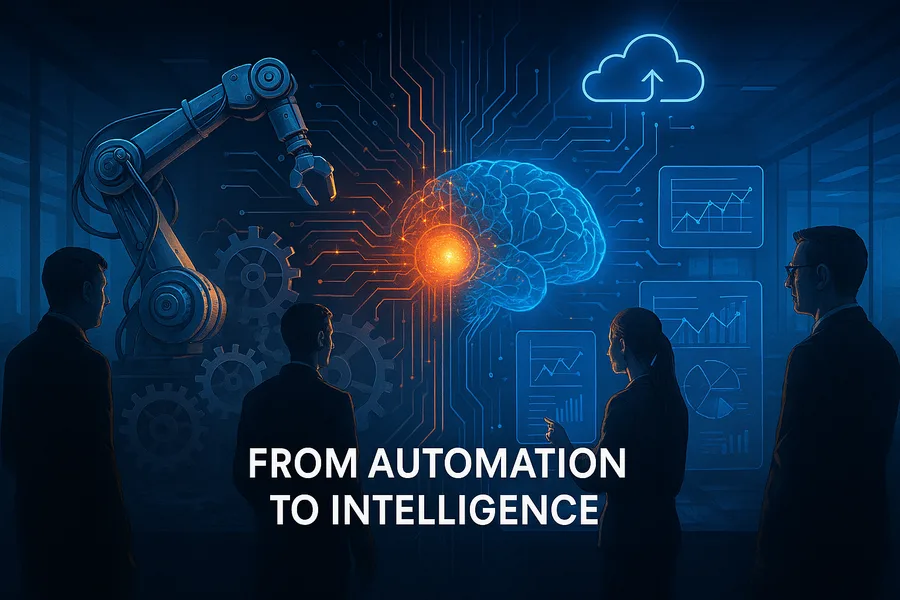
Automation eliminated the need to do work manually. Intelligence eliminates the need to think about it at all. That is not an incremental improvement. It is a categorical one.
Two Waves, One Revolution
The history of enterprise technology can be understood as two great waves of transformation. The first wave, spanning from the 1980s through the early 2000s, was the automation wave. Businesses replaced manual processes with software. Payroll calculations, inventory tracking, order processing, financial reporting — task after task moved from clipboards and spreadsheets to digital systems. Efficiency soared. Headcounts were reallocated. A new category of enterprise technology was born.
The second wave — the intelligence wave — is unfolding right now. And it is categorically different from the first. Automation made businesses faster at doing what they already knew how to do. Intelligence is making businesses capable of things they could never do before: real-time pattern recognition across millions of data points, predictive decision-making under uncertainty, dynamic adaptation to changing conditions, and autonomous execution of complex multi-step processes.
Most business leaders intellectually understand this distinction. Far fewer have fully grasped its operational and strategic implications.
What Automation Could Never Do
To appreciate the magnitude of the intelligence wave, it helps to be precise about what automation was fundamentally incapable of delivering.
Automation excelled at structured, repetitive tasks with well-defined rules. It struggled with ambiguity, nuance, and novelty. A rules-based automation system could process a standard invoice flawlessly ten thousand times. But present it with an invoice formatted differently than expected, flagged for unusual terms, arriving during a period of supply chain disruption, and written in a language not covered by the system's rules — and it failed, routing the exception to a human whose time was consumed by exactly the kind of edge case that scales poorly.
The dirty secret of enterprise automation was always the volume of exceptions. Studies consistently found that in complex business processes — procurement, compliance, customer resolution, financial reconciliation — exceptions often consumed 30 to 50 percent of the total human effort in a department. Automation solved the easy 50 percent. It left the hard half largely untouched.
AI-powered platforms do not just handle the easy cases faster. They handle the hard cases intelligently. That is the breakthrough that separates this era from everything that came before.
The Architecture of Intelligence Platforms
AI-powered business platforms are architecturally distinct from their automation predecessors in ways that go far beyond a better algorithm. The differences are structural.
Traditional automation platforms were designed around fixed workflows: if this, then that, else escalate. The logic was explicit, deterministic, and authored by humans. Changing the logic required re-programming. The system's behavior was bounded by the imagination of whoever wrote the rules.
Intelligence platforms are designed around learned behaviors. They observe patterns across vast datasets, build probabilistic models of outcomes, and make decisions based on those models. The logic is implicit, adaptive, and discovered from data rather than authored by hand. As the data changes, the behavior evolves. The system is not bounded by human imagination because it is not following human rules.
This architectural difference produces a compounding advantage that grows over time. Every transaction an intelligence platform processes makes its models slightly more accurate. Every exception it handles correctly refines its understanding of edge cases. Every prediction it makes is evaluated against eventual outcomes, feeding a continuous learning loop that automation systems were never designed to support.
Where Intelligence Platforms Are Delivering Real Value
The transition from automation to intelligence is not theoretical. It is already producing measurable business outcomes across industries.
In financial services, AI-powered fraud detection platforms have reduced false positive rates by 40 to 60 percent compared to rules-based predecessors — meaning fewer legitimate transactions blocked and lower customer friction — while simultaneously improving detection rates for genuinely fraudulent activity. The rules-based systems that preceded them required constant manual tuning by fraud analysts. The intelligence platforms tune themselves.
In supply chain management, AI-powered demand forecasting platforms have reduced inventory holding costs by 15 to 25 percent in documented deployments while simultaneously improving service levels. They achieve this by integrating signals that no rules-based system could incorporate: social media trends, weather patterns, economic indicators, competitor pricing, and hundreds of other variables that influence demand but were previously impossible to synthesize at scale.
In customer experience, AI-powered service platforms are resolving interactions that would have required skilled human agents in ways that achieve higher satisfaction scores than those agents consistently delivered. Not because the AI is more empathetic, but because it has instant access to complete customer history, relevant product knowledge, and real-time context that no human agent can reliably assemble in the first 30 seconds of an interaction.
The New Skill Set for the Intelligence Era
The shift from automation to intelligence demands a parallel shift in the capabilities enterprises must develop and cultivate.
The most critical new capability is what might be called intelligent process design: the ability to identify which business processes are genuinely suited to AI-powered automation, how to structure the human-AI collaboration model within those processes, and how to design feedback loops that keep the intelligence improving over time. This is a fundamentally different discipline from traditional process engineering, and most enterprises are still developing the internal talent to practice it.
Data literacy across the organization is equally essential. Intelligence platforms live and die on data quality. Every function that feeds data into an AI-powered platform — and in mature deployments, that means nearly every function — must develop sufficient understanding of data standards, governance, and quality management to be a responsible contributor to the enterprise intelligence ecosystem.
The Bottom Line
Every major technological era in enterprise history has produced a divide between organizations that rode the wave early and those that waited too long. The automation era was no different. The companies that automated well in the 1990s built efficiency advantages that funded the next decade of growth. The laggards spent the same decade closing the gap instead.
The intelligence era will be no different, except that the stakes are higher and the timeline is shorter. The platforms are mature enough to deploy. The business cases are proven. The competitive dynamics are clarifying. The era of automation served enterprises well. The era of intelligence will serve them better, but only the ones willing to build AI-powered platforms with genuine commitment and strategic clarity.