The question is no longer whether your enterprise needs AI. The question is whether your enterprise was built for it.
The Old Foundation Is Cracking
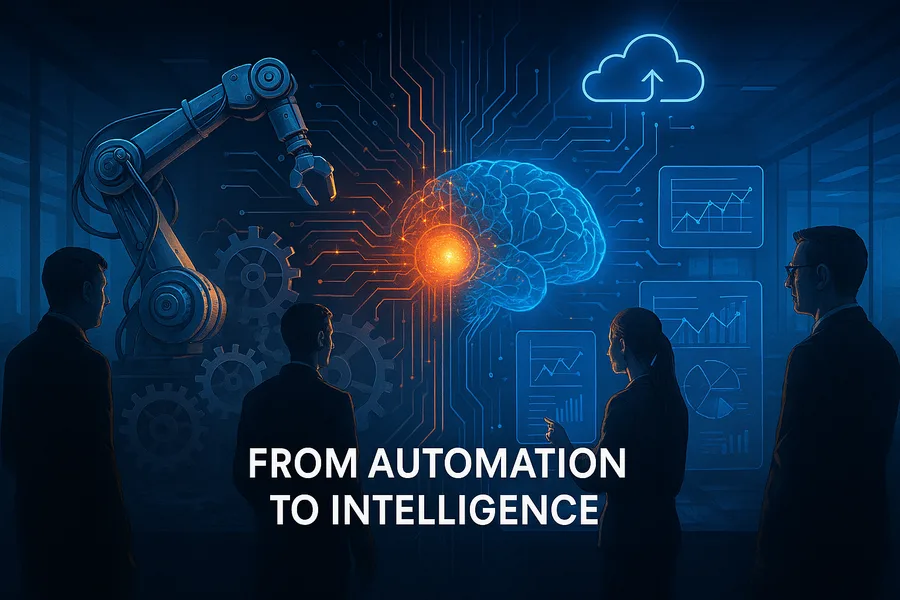
For decades, enterprise software was built around a simple but powerful idea: automate the predictable. ERP systems standardized finance. CRM platforms tracked customers. Supply chain tools scheduled logistics. These systems were rigid by design. They were built to do exactly what they were told, nothing more, nothing less.
That rigidity was once a virtue. In a world where business processes changed slowly and competitive advantages were measured in years, stability mattered more than adaptability. IT departments prided themselves on uptime, not insight.
But that world is gone. The pace of change in markets, customer behavior, regulatory environments, and competitive dynamics has outpaced what rule-based software can handle. The result? A widening gap between what legacy applications can do and what modern enterprises actually need.
What Makes an Application "AI-Native"?
There is an important distinction between an AI-enabled application and an AI-native one — a distinction that many executives and technologists still blur to their own detriment.
An AI-enabled application is a traditional system with artificial intelligence bolted on. Think of a customer service platform that adds a chatbot widget. The core architecture remains unchanged. The AI sits at the edge, handling a narrow slice of interactions before handing off to the legacy system underneath.
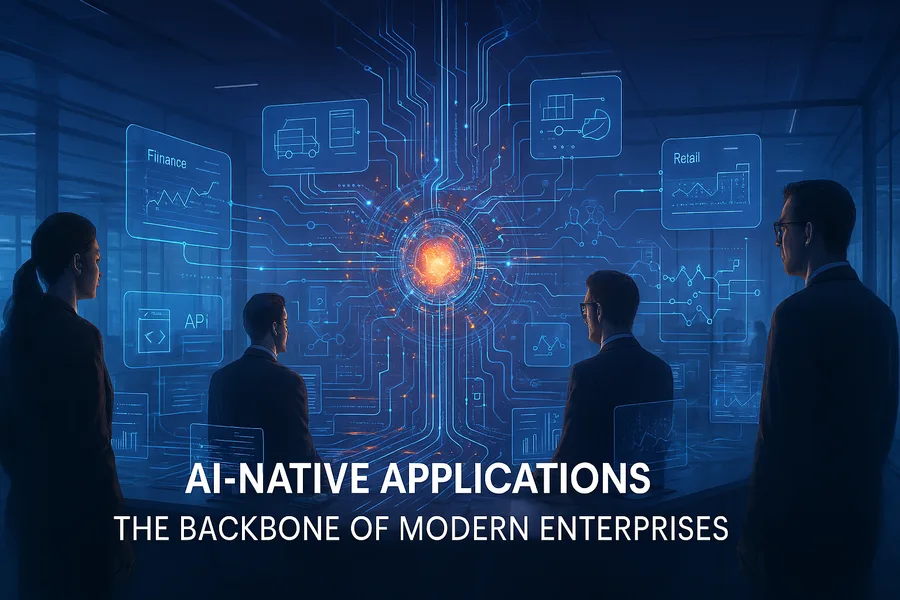
An AI-native application, by contrast, is designed from first principles with intelligence at its core. The data model, the decision logic, the user experience — all of it is built around the assumption that the system will continuously learn, adapt, and reason. AI is not a feature in these applications. It is the architecture.
AI-native is not a product category. It is a design philosophy — one that treats intelligence as the primary mechanism of value creation, not a supplement to it.
Why Enterprises Are Making the Shift
The business case for AI-native applications has become difficult to ignore. Enterprises that have made meaningful investments in AI-native infrastructure are seeing compounding returns in three specific areas:
First, operational responsiveness. AI-native systems can process and act on data in real time, dynamically adjusting workflows in ways that static software simply cannot. A procurement platform that can detect supply disruptions, assess alternatives, and execute contingency plans autonomously is not just faster — it is fundamentally more capable than any legacy equivalent.
Second, personalization at scale. Modern customers, both consumers and business buyers, expect experiences tailored to their context, history, and intent. AI-native CRM and marketing platforms can deliver this personalization dynamically, across millions of interactions simultaneously, without human intervention.
Third, knowledge compounding. Every transaction, every interaction, every exception handled by an AI-native system feeds back into its intelligence. Over time, these systems become genuinely smarter. The longer an enterprise runs on AI-native infrastructure, the wider its analytical and operational advantage grows relative to competitors still running on legacy platforms.
The Structural Challenges of Transition
None of this comes without friction. Enterprises transitioning to AI-native applications face real structural challenges that demand honest reckoning.
Data quality is the most persistent obstacle. AI-native systems are only as intelligent as the data they ingest. Decades of inconsistent data governance, siloed systems, and poorly defined taxonomies mean that most large enterprises are working with data that is messier than their teams fully appreciate. Before AI-native applications can deliver on their promise, that data infrastructure must be addressed seriously.
Organizational culture is the second challenge. AI-native applications shift decision-making from humans to systems in ways that can feel threatening to established hierarchies. Middle management layers built around information aggregation and reporting find their roles disrupted. Cultures that have long rewarded human judgment over systematic analysis often resist the transition, sometimes subtly, sometimes openly.
Vendor maturity is the third. The market for AI-native enterprise software is still maturing rapidly. Not every vendor promising AI-native capabilities has actually built them. Enterprises must develop rigorous evaluation frameworks to distinguish genuine AI-native architecture from legacy systems wearing new marketing.
The Competitive Imperative
Here is the uncomfortable truth that every enterprise leader needs to absorb: the transition to AI-native applications is not optional. It is a competitive survival issue.
Industries that have seen early AI-native adoption — financial services, logistics, e-commerce, digital healthcare — are already showing bifurcation. Companies that built or adopted AI-native platforms early are accelerating. Those still running on legacy infrastructure are falling further behind with each passing quarter.
The timeline for transition is compressing. Three years ago, enterprises had the luxury of watching, learning, and planning. Today, that window is closing. The first-mover advantages in AI-native adoption are real and they compound over time. Every quarter of delay is a quarter of intelligence your competitors are building that you are not.
The Path Forward
The path to AI-native enterprise architecture is rarely a single, sweeping transformation. For most organizations, it is a deliberate, sequenced migration that begins with identifying the highest-value business processes, rebuilding them on AI-native foundations, and expanding from there.
The enterprises that will lead the next decade are not necessarily the ones with the biggest IT budgets. They are the ones with the clearest vision of what AI-native development means for their specific industry and the discipline to build toward it systematically. The backbone of the modern enterprise is being rebuilt — whether through purpose-built enterprise software or AI-first platforms. The only real question is whether your organization will rebuild it on your own terms or be forced to catch up on someone else's.