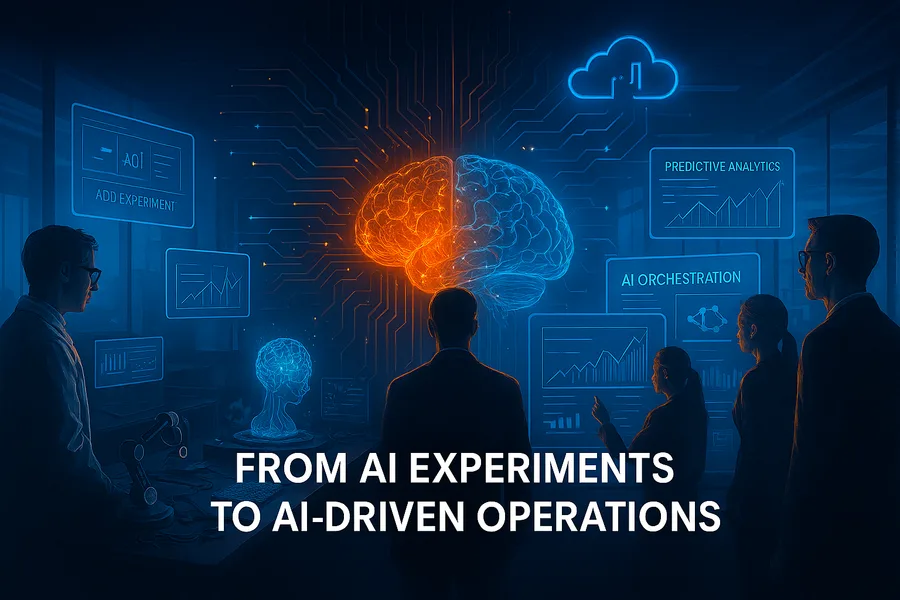
A proof of concept that never leaves the lab is not innovation. It is expensive theater. The enterprises winning with AI are the ones that have learned to operationalize it.
The Pilot Paradox
Across industries and geographies, a remarkably consistent pattern has emerged in enterprise AI adoption. Organizations run a pilot. The pilot succeeds. Stakeholders are impressed. And then... nothing happens. Months pass. The pilot results sit in a slide deck. The data scientists who built the model move on to the next experiment. The business problem the pilot was designed to solve remains largely unchanged.
This pattern has been so common and so persistent that researchers have given it a name: the pilot paradox. Enterprises that are sophisticated enough to run AI experiments are simultaneously unable to translate those experiments into operational reality. The gap between proof of concept and production deployment has been, for many organizations, effectively insurmountable.
Understanding why this gap exists — and how leading enterprises are systematically closing it — is one of the most important strategic questions in enterprise technology today.
Why Pilots Fail to Scale
The root causes of the pilot-to-production gap are well documented at this point, even if they remain under-addressed in practice.
The first cause is what might be called the clean data illusion. Most AI pilots are built on carefully curated datasets — clean, well-labeled, historically consistent data assembled specifically for the pilot. When the model moves toward production, it encounters the real data environment: messy, inconsistent, poorly labeled, and structured in ways that reflect years of accumulated technical debt. The model that performed beautifully in the pilot degrades badly in production, and the organization lacks the data infrastructure to fix the underlying problem at speed.
The second cause is integration complexity. Enterprise AI models do not operate in isolation. They need to read from and write to existing systems — ERPs, CRMs, databases, data warehouses, operational platforms — many of which were never designed to interact with AI components. Building the connective tissue between an AI model and the enterprise's existing technology stack is often far more complex and expensive than building the model itself. Organizations consistently underestimate this and are caught flat-footed when pilots reach the integration phase.
The third cause is organizational resistance. Every AI model that moves into production displaces some existing human process or decision. Someone owns that process. Someone has built their role, their team, and their political capital around that process. They rarely greet displacement enthusiastically. Without deliberate change management and executive sponsorship, organizational resistance quietly strangles AI deployments long before they reach their potential.
The enterprises that have cracked the pilot-to-production problem share one characteristic above all others: they treat AI deployment as an organizational challenge first and a technology challenge second.
What AI-Driven Operations Actually Look Like
There is significant confusion in the market about what it means for an enterprise to be AI-driven in its operations. The term is used loosely, applied to everything from a single chatbot deployment to a fully transformed operating model. Precision matters here.
A genuinely AI-driven operation is one where artificial intelligence is embedded in the decision-making and execution loops of core business processes — not as an advisory tool that humans can choose to consult, but as an active participant that processes information, generates recommendations or decisions, and triggers actions as a standard part of how work gets done.
In a supply chain context, this means AI systems that continuously monitor inventory levels, demand signals, supplier performance, and logistics capacity, and that automatically adjust purchase orders, production schedules, and distribution plans within defined parameters without waiting for human review of each decision.
In a financial context, this means AI systems that continuously monitor transaction flows, flag anomalies, assess credit risk, optimize cash positions, and generate compliance reports as living documents rather than periodic snapshots requiring manual assembly.
In a customer operations context, this means AI systems that handle the full lifecycle of the majority of customer interactions — inquiry, resolution, follow-up, feedback capture — while simultaneously surfacing patterns across those interactions to improve product development, pricing strategy, and service design.
The Operating Model for AI-Driven Organizations
Enterprises that have successfully moved from AI experiments to AI-driven operations have built a set of organizational capabilities that distinguishes them from their still-experimenting peers.
They have established AI product management as a discipline. Rather than treating AI deployments as IT projects, they manage them as products — with dedicated product managers, defined success metrics, roadmaps, user feedback loops, and regular iteration cycles. The AI model is version 1.0, not a finished deliverable.
They have built MLOps infrastructure — the operational machinery that manages AI models in production. This includes monitoring systems that detect model drift, automated retraining pipelines that keep models current as data patterns evolve, testing frameworks that catch degradation before it reaches users, and governance processes that ensure compliance and auditability.
They have developed human-AI teaming protocols that specify clearly which decisions are made by AI autonomously, which decisions are AI-recommended and human-confirmed, and which decisions remain fully human. These protocols are not static — they evolve as trust in the AI systems grows and as organizational confidence develops.
The Governance Question
No discussion of AI-driven operations is complete without addressing governance — a topic that many enterprises engage with superficially but few have truly resolved.
AI systems making operational decisions create accountability challenges that traditional governance frameworks are not designed to handle. When an AI-driven procurement system makes a purchasing decision that turns out to be wrong, who is accountable? When an AI-driven risk model misclassifies a loan applicant, what is the process for review and redress? When an AI-driven HR platform recommends against hiring a candidate, how is bias assessed and challenged?
The enterprises that are successfully scaling AI-driven operations have developed governance frameworks that answer these questions explicitly. They treat AI accountability not as a legal or compliance afterthought but as a core operational design requirement, built into every deployment from the earliest stages of planning.
The Inflection Point
Enterprise AI adoption is at an inflection point. The early majority of enterprises — the ones that ran experiments, learned the lessons, and are now deploying seriously — are separating from the late majority that is still primarily in pilot mode. The separation is not merely about technology investment. It is about organizational capability, data infrastructure, operating model design, and governance maturity.
The enterprises that crack this transition in the next 12 to 24 months will build operational advantages that are genuinely difficult for laggards to close. AI-driven operations compound: better data leads to better models, which leads to better decisions, which generates more and better data. The flywheel, once spinning, accelerates. Getting it spinning is the hard part — and our AI software development team has done it before. The time to start is now.