You’ve seen the magic. You give an AI a prompt, and in seconds, it generates a block of code. It writes a function. It scaffolds an entire module.
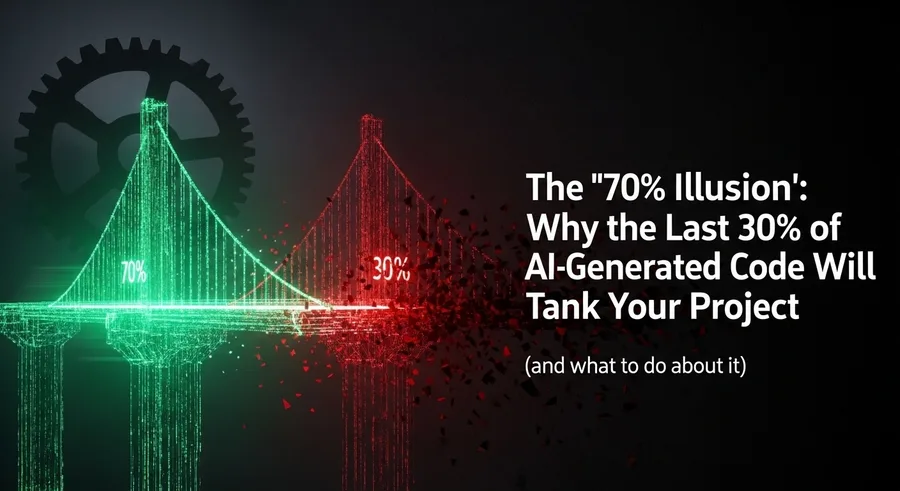
It’s fast, it’s clean, and for a glorious moment, it feels like you’ve unlocked a superpower. Your project is 70% done in 10% of the time. The hype, it seems, is real.
But here’s the uncomfortable truth no one tells you:
You will inevitably hit the wall. The crucial last 30%.
This is where the real work begins. This is where the AI hands you the keys to a beautifully designed car that has no engine, and says, "You figure out the rest."
If you're building anything more than a prototype, that last 30% is where the entire value of your project lies. It's the difference between a cool demo and a secure, production-ready system.
🤔 What Exactly is in This Crucial 30%?
This is the non-negotiable, senior-level work that AI cannot yet touch:
- The "Why" Behind the "What": AI gives you code, but it doesn't give you the business logic nuances. It hasn't sat in the meeting where the client explained their unique, convoluted data validation rule that’s existed since 2003. The 30% is integrating the reason the software exists.
- 🏗️ Architectural Integrity: An AI can write a function, but it can't design the entire system architecture. It doesn't understand how this new module must seamlessly talk to your legacy ERP system, or how it will scale under 10,000 concurrent users. The 30% is the glue, the plumbing, and the foundation.
- 🔒 Security & Compliance: AI is notoriously optimistic. It will write code that works, but is it secure? Does it contain hidden vulnerabilities? Does it handle data in a way that complies with GDPR or HIPAA? The 30% is the rigorous, non-negotiable security audit and compliance hardening.
- 🌪️ Edge Cases & Error Handling: The AI handles the "happy path" beautifully. But what happens when the API is down? When the user uploads a 10GB file? When the data is malformed? The 30% is anticipating the infinite ways things can go wrong and building a system that is robust, not just functional.
- 🚀 Performance Optimization: The code runs. But is it efficient? Does it have memory leaks? Could that database query be optimized from 2 seconds to 200ms? The 30% is the meticulous profiling and tuning that separates a sluggish application from a lightning-fast one.
Real-World Reality Check: We recently ran a test for a client where the AI built the core CRUD (Create, Read, Update, Delete) module in minutes. However, the manual work—creating the necessary wrappers and integrating that module with their 15-year-old, proprietary financial API—took our senior engineer three full days. The 70% was fast, but the 30% required true expertise.
The New Role of the Developer (and the Consultancy)
It's not about being replaced. It's about being upgraded.
We are no longer just code writers; we are becoming code curators, system architects, and business-logic translators. Our value has shifted up the stack.
We use the AI's 70%—the first draft, the boilerplate, the repetitive tasks—as a powerful starting point. This frees up our most critical asset: time. Time we can now invest in the high-value, complex problem-solving that the AI cannot touch.
That last 30% is where strategy, experience, and deep understanding come to life. It's where we ensure the software doesn't just work, but that it is secure, scalable, maintainable, and actually solves the business problem it was intended to.
At TechConnectUSA, we see AI development as the ultimate accelerator: incredibly fast, wildly knowledgeable, but one that needs constant guidance and a senior engineer to review its work before it goes to production.
The question for you and your team isn't "Can an AI do this?" The question is, "Who is going to own the crucial 30%?"