
One systemto runthe company on.
Custom business software that replaces the tangle of spreadsheets, SaaS subscriptions, and email chains your teams stitch together today. Sales, ops, finance, and HR working from one place.
Three rules. Every rollout. No exceptions.
“Software has to match the way your team actually works.”
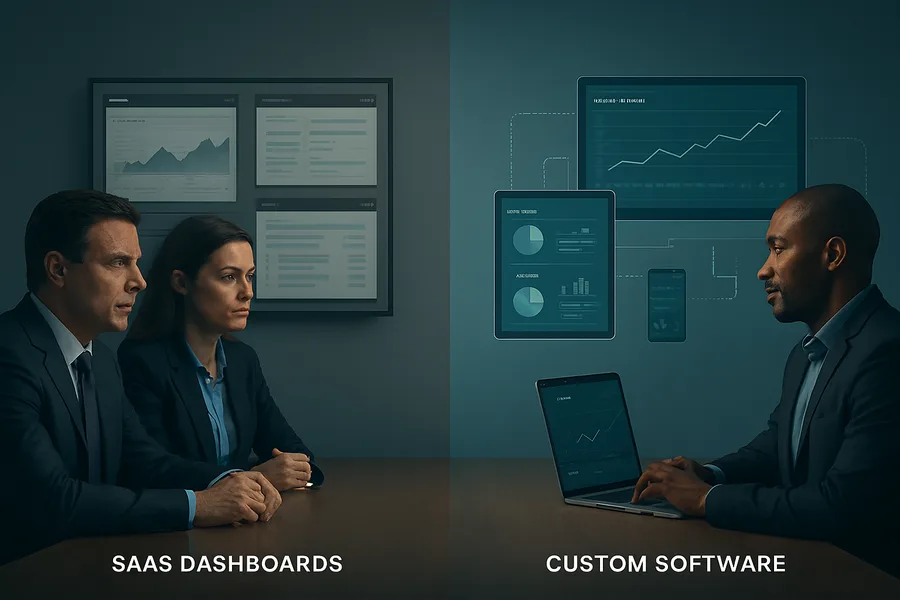
Off-the-shelf SaaS asks your team to bend around the tool. Custom systems do the opposite. We sit with your people for a week before we draw the first screen, and the build mirrors the words your team already uses.
“A working pilot in four weeks beats a perfect plan in a year.”
Big-bang rollouts get blamed for everything and waste budget. We ship a single workflow for a single team first, watch it earn trust, then grow the system one department at a time. Old tools sunset on a schedule, not a Monday.
“Your code, your cloud, your data. No lock-in clause.”
The repo lives in your GitHub. Hosting under your AWS or Azure account. Your IT team gets the keys on day one. You can hire any developer to extend the system after we hand it over, and the build will still make sense to them.
Every team writes to one source of truth.
Sales, ops, finance, HR, and the tools you already pay for, all sending events into one platform. No more stitching reports across nine tabs at month-end.
Average across a 60-person rollout, after 90 days.
Of records reconciled live, no nightly batch jobs to babysit.
- Invoice paid → Slack #finance
- New hire → role + access
- Stock low → PO drafted
Most companies do not need more software.
They need fewer tools, doing more for them. Here is what that looks like for an ops team, before us and after us.
- Seven different tools held together by email
- Spreadsheets passed by attachment
- Quarterly reports stitched together by hand
- New hires figuring it out by asking around
- Knowledge that lives in three peoples heads
- One system everyone signs into
- One source of truth, updated live
- Live dashboards that refresh themselves
- Roles, workflows, and access set on day one
- Documented in the workflow itself
Six modules, mixed to fit. Tap one.
You do not need every module on day one. Pick the two that hurt the most, ship those first, add the rest in phases.
Custom CRM.
Customer records, pipeline stages, and notes shaped around how your team actually sells, not how a SaaS tool wants you to.
- Pipeline stages your reps recognize, not generic Salesforce ones
- Account history with notes, files, and email threads in one place
- Quote builder that talks to invoicing in one click
- Forecast view leadership can read without a Monday meeting
What it pays back, in plain numbers.
Hours your team gets back, tools you stop paying for, and how fast people find the answers they need. Not vanity metrics. Numbers we have hit on real client launches.
Across a 40-person team, after rollout.
Spreadsheets and SaaS subscriptions retired.
Search across customers, jobs, invoices.
Hours given back, cumulative.
first 12 monthsEvery line of automation we ship pays itself back, then keeps paying.
One team learns. Then teaches the next.
Big-bang launches scare people, get blamed for every problem, and waste budget. We grow the system one team at a time, with a working pilot in weeks.
Map the workflows
Sit with each team. Walk through how work moves today, where it slows, and what would actually save the most time.
Pilot with one team
Pick a single department and a single workflow. Ship it, watch them use it, fix what is awkward before we scale it.
Roll to the department
Onboard the rest of the team, migrate live data, run the old and new system in parallel until everyone is comfortable.
Bring in the company
Sales, ops, finance, support. Each team plugged in with their own roles and dashboards. Old tools sunset on a schedule.
Tune and grow
Quarterly reviews of what is being used, what is not, and what to automate next. The system grows with the company.
Wired into the tools you already run.
You should not have to abandon QuickBooks, Salesforce, or Microsoft 365 to gain a new system. We connect to the tools that already work.
Plus anything with a public API. Custom integrations quoted in week one.
The boring checklist. Already ticked.
Security and compliance baked in from day one. Not bolted on after the audit fails.
Four reasons mid-market picks us over a big-name consultancy.
We sit with the people who use it
Software written for a slide deck fails. We watch your team work for a week before we draw a single screen.
Migration without a downtime weekend
Old system and new system run in parallel until your team trusts the new one. No big-bang cutover, no Monday morning panic.
Audit-ready from day one
Logs, role permissions, and data export built in. Your auditor and your IT team get what they need without a scramble.
Owned by you, hosted where you want
Your code, your cloud account, your database. Move providers without asking us first. No vendor lock-in clauses.
Questions, Answered
Frequently Asked Questions
Enterprise software development is building custom applications that run core business operations, such as ERP, CRM, and internal platforms. These systems connect departments, automate workflows, and remove the limits of off-the-shelf tools.
Most enterprise builds run four to nine months, depending on scope and integrations. We ship in phases, so you get a working core early and add modules from there. You see a timeline with milestones before development starts.
Yes. We connect to your current ERP, CRM, payment, and data systems through APIs and secure data pipelines. If a system has no API, we build a safe integration layer around it.
Enterprise projects typically range from $60,000 to $250,000 based on scope, integrations, and compliance needs. We give a fixed price after a free scoping call and phase the work so cost tracks delivered value.
From Our Blog
Related Insights

Want intelligent features in your platform? Explore our AI development services
Tired of runningon spreadsheets?
Tell us the two workflows that hurt the most. In a 30-minute call we will map the smallest pilot that proves the system, what it would cost, and how soon your team can use it.