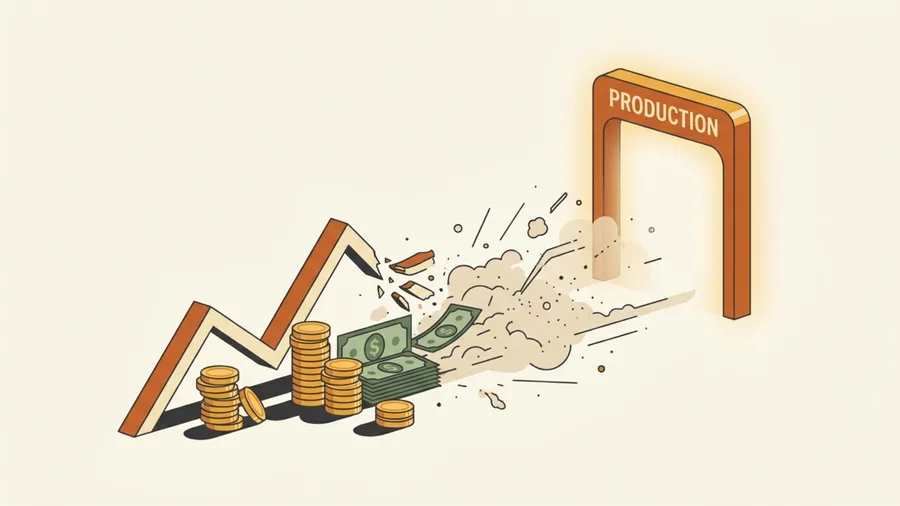
Enterprise AI spend hits $665B in 2026, yet 73% of deployments fail to deliver ROI. Here's the real reason your AI investment stalled and what actually fixes it.
$665 billion. That is what enterprises will spend on AI in 2026.
And yet, according to a recent Deloitte report, 73% of AI deployments are failing to deliver their projected return. MIT researchers found that 88% of AI proofs of concept never make it to production. Somewhere between the budget approval and the board presentation, the money vanishes.
This is not a technology problem. It is a strategy problem and most organizations are still misdiagnosing it.
There is a pattern behind nearly every failed AI investment. It shows up across industries, company sizes, and tech stacks. Understanding it is the difference between a compelling case study and a very expensive science project.
The POC That Was Never Meant to Ship
Most AI initiatives start in a lab. A small team, a clean dataset, an optimistic timeline. The proof of concept works. Leadership gets excited. The demo looks great on a Tuesday afternoon.
Then nothing happens.
The POC sits in a staging environment for six months while engineers debate infrastructure, legal reviews the data governance policy, and the original champion gets pulled onto something else. By the time anyone circles back, the model is stale, the vendor has released two new versions, and the business case needs to be rebuilt from scratch.
This is POC purgatory. And it is where the majority of enterprise AI budget goes to die.
The problem is not that the technology failed. The problem is that nobody designed the project to survive contact with a real production environment.
You Are Measuring the Wrong Things at the Wrong Time
Here is how most AI projects get evaluated: a pilot runs for 90 days, produces a report, and then gets measured against a KPI that was defined before anyone understood what the tool actually did.
That is backwards.
Successful AI deployments define success metrics based on what the system can realistically influence, and they instrument those metrics from day one. Not from the day the pilot ends. They ask: what decision does this model change? What action does it enable or prevent? What is the dollar value of getting that decision right 15% more often?
Without that framing, "AI accuracy" becomes a vanity metric. You end up celebrating a model that is 94% accurate while the business problem it was supposed to solve continues costing you money.
Your Data Is Not Ready, and Nobody Told You
This is the one nobody wants to say out loud. Enterprise data is messy. It is siloed across legacy systems, inconsistently labeled, partially governed, and often missing the very fields that would make an AI model actually useful.
Most organizations discover this six weeks into a project. By then, the timeline has slipped, the vendor is asking for a scope extension, and the CTO is fielding uncomfortable questions from the CFO.
A realistic AI deployment timeline builds data readiness into phase one. That means:
- Auditing what data exists, where it lives, and who owns it
- Identifying gaps before training begins, not after
- Establishing a governance framework that legal and IT have both signed off on before a single model is trained
Organizations that skip this step do not save time. They lose six months later instead of three weeks now.
The Team You Have Is Not the Team You Need
Most enterprises staff AI projects with whoever is available. A developer who has done some Python. A data analyst who watched a few tutorials. A project manager who ran a cloud migration two years ago.
That team can build a demo. It cannot build a production system.
Production AI requires a specific combination: ML engineers who understand deployment constraints, data engineers who can build reliable pipelines, and a technical lead who has actually shipped something similar before. Not someone who has read about it. Someone who has done it.
The organizations seeing real ROI from AI are not necessarily spending more money. They are spending it on people who have been in production environments, who know what breaks at scale, and who build with the endpoint in mind from the first sprint.
What Actually Works
The enterprises pulling real returns from AI share a few traits. They scope small and ship fast, a single workflow, a specific decision, a contained process. They treat week one as a production week, not a planning week. They define "done" as a system running in the real environment, not a report sitting in a deck.
They also kill projects early. If a use case does not have a clear production path within the first four weeks, they stop. Not because they lack conviction, but because they understand that the cost of a slow failure is always higher than the cost of an early exit.
AI is not going to save your company if you buy it like software and manage it like a research project. The ROI is real. But it requires engineering discipline, not just executive enthusiasm.
The question is not whether to invest in AI. Most of you already have. The question is whether the next dollar goes toward another proof of concept, or toward something that ships.