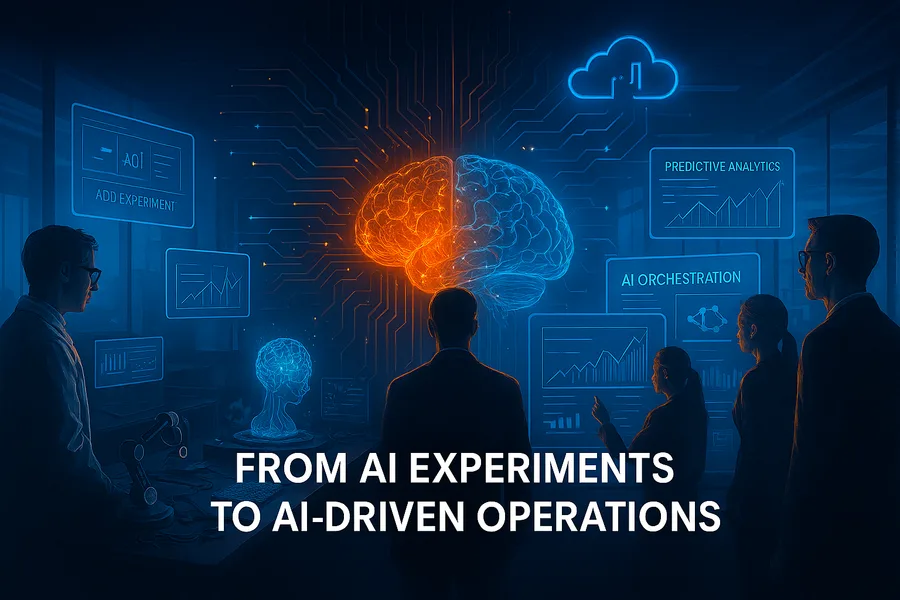
In an era of “AI-powered” claims, true transformation requires weaving intelligence into everyday operations so technology becomes a natural extension of how work gets done.
The Integration Imperative: Why Surface-Level AI Fails
Many AI initiatives fail not because the technology is weak but because implementations are superficial and fail to integrate into workflows, systems, and culture.
Approximately 85% of AI projects fail to move from pilot to production, largely due to poor integration planning.
The Foundation: Understanding Before Building
Effective integration starts with discovery: mapping processes, identifying pain points, understanding data flows, and pinpointing where human judgment matters most.
Business Process Analysis
Analyze decision points, handoffs, and bottlenecks to identify high-impact opportunities where AI can improve speed, accuracy, or throughput.
Data Ecosystem Mapping
Identify sources, quality issues, and accessibility gaps—often revealing previously untapped data assets essential for reliable AI.
Stakeholder Engagement
Include executives, managers, and front-line users early to surface constraints and ensure solutions fit real-world workflows.
Strategic Integration Principles
Start with High-Impact, Low-Complexity Opportunities
Begin with focused use cases that deliver clear value quickly to build confidence and momentum before scaling.
Build for Scalability from Day One
Design modular systems, establish data standards, and choose flexible platforms so early projects become foundations for broader adoption.
Prioritize User Experience
Embed AI into tools people already use and ensure interactions are intuitive—adoption follows usability.
Technical Integration Architecture
API-First and Microservices
Expose AI capabilities via APIs and microservices so features are reusable, scalable, and decoupled from specific applications.
Data Pipeline Automation
Automate extraction, transformation, and loading so models consume fresh, validated data with minimal manual effort.
Security and Compliance
Integrate encryption, access controls, and audit trails into AI services to meet regulatory and organizational requirements.
Domain-Specific Integration Examples
Customer Service
Connect chatbots with CRM, knowledge bases, and ticketing systems so agents receive context-rich suggestions and AI augments resolution workflows.
Sales and Marketing
Provide reps with AI briefings before calls, real-time transcription insights during conversations, and automated personalization across campaigns.
Financial Operations
Automate invoice extraction, matching, and exception routing while integrating predictive forecasts into planning systems.
Supply Chain
Integrate AI with ERP and logistics platforms to predict disruptions, optimize inventory, and enable automated corrective actions.
Overcoming Integration Challenges
Address legacy compatibility, data silos, and organizational change proactively with middleware, governance, and comprehensive training.
Measuring Integration Success
Track business outcomes, operational efficiency, and user adoption to understand value and guide continuous improvements.
High-performing integrations often reach 80%+ user adoption within 90 days, compared to 40–50% for average implementations.
The Path Forward
Treat AI integration as an ongoing capability—invest in centers of excellence, institutionalize best practices, and continuously assess where AI adds value.
Conclusion
When properly integrated, AI becomes invisible in the best sense: it simply makes work better, faster, and smarter—delivering measurable business outcomes.