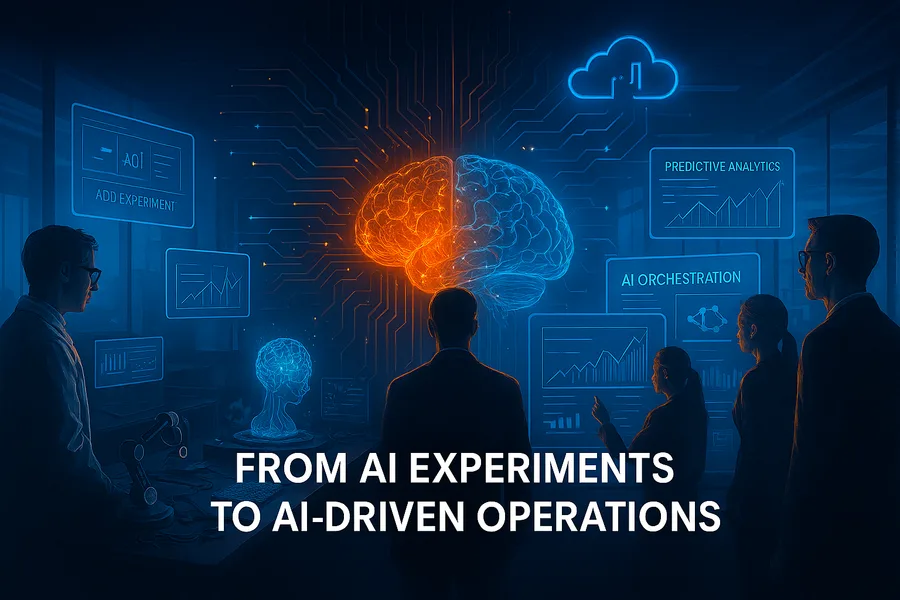
Most organizations didn’t fall behind because they ignored AI. They fell behind because they tried to layer intelligence on top of systems that were never designed to learn.
Cloud was implemented to scale operations. AI was added to automate decisions. Different goals. Different teams. Different outcomes.
This isn’t evolution. It’s a redesign of the foundation.
The Real Problem Isn't Technology
It's how organizations think about it. Cloud made scale cheap. AI made decisions programmable. Together, they enable systems that can respond faster than humans. Yet many companies still deploy AI on top of static cloud foundations — lifting old architectures into new environments and calling it transformation.
That's not innovation. It's technical debt dressed as progress.
When Intelligence Is Built Into The Platform
Systems respond automatically instead of waiting. Costs adjust in real time instead of after the fact. Features ship faster because infrastructure stops being the bottleneck. This is why cloud-native AI systems move faster with fewer people—not because of effort, but because of design.
Architecture Built for Learning, Not Just Scale
Legacy cloud architecture was designed for flexibility. Modern architecture is designed to think. General-purpose environments are giving way to specialized compute optimized for training AI models, real-time inference, and rapid decision-making.
The impact is structural: workloads that once required heavy planning now adapt dynamically. Engineers spend less time tuning systems and more time building products. Modern platforms don't just run. They learn, adjust, and improve.
Serverless AI Made Intelligence Accessible
One of the most transformative shifts is accessibility. Serverless AI removes the need to manage infrastructure, scaling, or capacity. Teams can deploy language models, computer vision, forecasting, and recommendation engines through APIs — no specialized hardware, no ops overhead.
This democratizes intelligence. Small teams can deliver enterprise-grade outcomes. Innovation no longer requires a massive budget or elite squad.
Infrastructure That Manages Itself
The biggest change isn't AI inside apps. It's AI managing the platform itself. Modern cloud environments behave like autonomous systems: resources scale before demand spikes, costs optimize continuously, and failures are predicted, not just reacted to.
Security becomes proactive: systems detect anomalies and respond in real time. Compliance moves from periodic audits to continuous enforcement. No tickets. No waiting. No fire drills.
Intelligence at the Edge
Centralized cloud is powerful — but it isn't enough for every problem. Some decisions can't wait for round-trip latency or constant connectivity. Retail systems personalize experiences instantly. Industrial machines detect defects in real time. Sensitive data stays local while models learn and share insights without exposing raw information.
Distributed and federated learning solves three problems at once: speed, privacy, and resilience. This isn't optional anymore. It's becoming standard for high-stakes environments.
The True Constraint Is Organizational
Technology is ready. Many organizations are not. Companies that win focus on three things:
- Break silos between infrastructure and intelligence
- Upskill teams to operate smarter, not just hire externally
- Shorten feedback loops so systems — and humans — learn faster
The enemy isn't complexity. It's static thinking applied to dynamic systems.
This Is a Foundation Shift, Not an Upgrade
Cloud–AI convergence doesn't create advantage by itself. It removes friction everywhere else. In systems that sense, decide, and adapt continuously, scale stops being differentiating — learning speed becomes the true edge.
Are you managing infrastructure that reacts slowly… or orchestrating systems designed to learn?
Because once intelligence becomes part of the foundation, everything built on top of it moves faster. If legacy system modernization is what stands between you and that foundation, that is where the work starts.