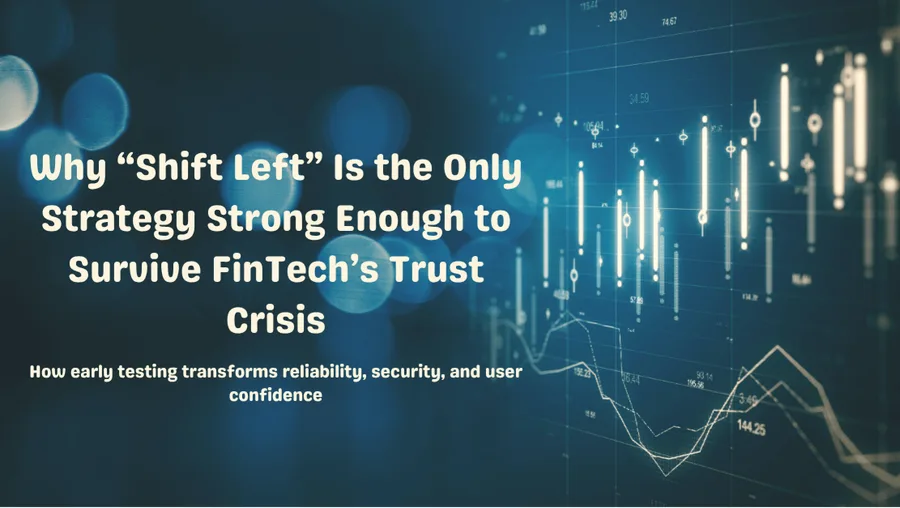
How early testing transforms reliability, security, and user confidence
In the world of FinTech, we don't just process data; we manage human beings' life savings, mortgages, and investment futures.
Trust is not a feature. It is the only currency that matters.
Imagine the scene: It’s 9:30 AM EST, markets are opening, and your core payment API returns a $0.01 calculation error on 1% of transactions. Within 24 hours, that "minor bug" has cost you millions in reputational damage, customer churn, and a regulatory audit.
This is the razor-thin margin of error we operate in. This is why comprehensive software testing is not a final checklist item—it is a non-negotiable, continuous discipline woven into the very fabric of FinTech development.
The Dangerous Myth of "It Works"
For a FinTech application, "working" is not enough. It must be a multi-layered shield of security, accuracy, and resilience.
What happens when you stop at basic functional testing? You leave the door open to failures in the three areas that will tank your company:
1. The Security Nightmare (The Digital Vault)
FinTech apps are prime targets. If your testing stops at ensuring a password works, you've already lost. We must continuously simulate attacks:
- Penetration Testing: Ethical hackers probing for vulnerabilities in API endpoints and authentication layers.
- Data Encryption Audits: Verifying that data at rest and in transit meets the highest standards (e.g., PCI-DSS).
The goal is not to prove you are secure; it is to fail the system before a malicious actor does.
2. The Performance Collapse (The Stampede)
A market crash, Tax Day, or a major partnership launch can instantly flood your application. Do you know what your app does under extreme pressure?
- Load Testing: Simulating thousands of concurrent users performing critical actions.
- Stress Testing: Pushing the system beyond its breaking point to find where it will fail, so you can engineer resilience.
A slow or crashing app during a critical financial moment is a failure that users will never forgive. They will simply go to your competitor.
3. The Compliance Fine (The Rulebook)
The financial industry is governed by an absolute web of regulations (AML, SOX, etc.). A missed legal requirement is not a bug—it’s a massive fine and a regulatory inquiry.
Compliance Testing: Ensuring every feature and data handling practice adheres to all legal mandates. Oversight here can cost you hundreds of thousands in penalties.
The Only Way Forward: SHIFT LEFT
The traditional model of "develop first, test later" is dangerously obsolete. A bug found after deployment is 100x more expensive to fix than one caught during the design phase.
Shift-Left isn't just about moving the QA team's calendar. It's a cultural mandate:
- Involve QA in Day 1: Testers review requirements and design documents before a single line of code is written.
- Ask the Hard Questions Early: "How will we test this complex calculation?" "Can this user flow be misinterpreted by the user?"
- Build Quality In: Focus on defect prevention rather than defect detection.
When you build quality in, you transform your QA team from a cost center (bug finder) into a value protector (risk mitigator).
Conclusion: Quality is Your FinTech’s Core IP
High-quality performance in FinTech is synonymous with reliability, security, and absolute accuracy.
Every dollar and every hour invested in a comprehensive, Shift-Left testing strategy is not an expenditure. It is a direct investment in your brand's integrity, your users' assets, and the financial foundation of your business.